Wednesday, January 19, 2011

Milkin' the Winning Streak in the East


1966 had proven to be a tasty year for Eastern, especially against Western. Eastern had drained the competition and claimed their fifth consecutive KISC Crown in swimming, their ninth OVC Baseball Crown, second place in the OVC in track and EKU's cross country team had captured their second straight OVC title. But best of all, Eastern had creamed Western in football with a score of 24-12.

With this winning-overload, it's not hard to believe that EKU could add yet another beefy win to their plate; however, no one expected the win would be delivered as actual beef.

Earlier in the year, Western had proclaimed that their cow's performance of 104,049 pounds of milk in 2, 838 days could not be equaled. However, Eastern's team at the Stateland Agriculture Center milked a win once again with miss Burke Ruth (who you see gracing this page) with 112, 197 pounds of milk in 2,808 days!!

Oh how sweet victory tastes!!

Wednesday, December 15, 2010

Why'd We Stop Decking the Halls??

Have you ever wondered where the popular holiday song "Deck the Halls" originated or why they're so excited about hanging holly? Well the song was written in honor of an old English custom in which people would..well..'deck their halls with holly.' Like all traditions, the custom inspired holiday spirit and set a mood for the merry season. Thus, many homes, work places, and institutions took on the popular tradition.
Inspired by the ceremonial tradition held at Peabody College, President Herman Donovan began the Hanging of the Greens (Eastern's version of Deck the Halls) in 1930. The ceremony consisted of females in white robes who would gracefully parade and hang mountain laurel in Burnam Hall the first week of December in celebration of the holiday season. Candle lighting, Christmas songs, and a guest speaker,usually a leader of one of the religious organizations on campus, would soon follow. This ceremony continued in Burnam until 1941 when it was moved to Keen Johnson to give the entire campus an opportunity to see the greens as they traveled in and out of KJ cafeteria.
Hanging of the Greens grew to include over 100 students in the procession alone. Members included those of the Mortar Board, Panhellenic Council, Interfraternities Council, Multi-Cultural Assosication, and many more. However, over time, the participation dissipated and in 1998, after 67 years of tradition, the Hanging of the Greens was canceled.
It's sad to think of all we simply let go over time, especially traditions. Traditions give us a common bond, a sense of pride and a surge of spirit that inspires us to grow, achieve, and even write songs that live forever, such as "Deck the Halls." So in the upcoming year, foster tradition and inspiration, cultivate creativity, and don't allow tradition to slip through the cracks of life.

Monday, November 15, 2010

Giving Back Retro-Style

There are always people in need. Some need food, others a home or a job, and some need an education. The list goes on and on and yet there are fewer and fewer people with the means or the will to help. So this holiday season, I want to take you back to the year 1959 when Elvis, bomb shelters, and giving to others were cool.

Judy Elizabeth Kendle had just finished up her first year as a college student of Eastern Kentucky State College. A resident of Dayton, Kentucky, she was a decent student, maintaining a B average, actively involved in her hall council, and had aspirations of becoming a third grades school teacher. However, Judy's dream would be short lived unless she came up with the $300 for next year's tuition ($300??!! I know what you're thinking..but this is 1959, remember?) . Desperate for funding options, Judy appealed to the president of the institution, Mr. W.F. O'Donnell.

President O'Donnell listened intently to his students. Above all else, he wanted to insure their success, which would insure the college's success as well. So when Judy pleaded to continue her education, President O'Donnell went to work on an ingenious plan. He knew that Keeneland had offered a full four-year scholarship since 1956. However, he also knew that due to the loss of Keeneland's tax-exempt status, Keeneland would no longer provide new scholarships. But, as fortune would have it (well, Judy's good fortune), the young lady who had won the scholarship the previous year had dropped out of school. Therefore, President O'Donnell instructed Judy to write an essay about why she needed the scholarship and extended the offer to Miss Judy E. Kendle. Judy accepted and because of the generous donations and thoughtfulness of others, was able to continue her education.

So give back a little this holiday season. Giving just a little may cause a huge amount of change for another. It doesn't have to be a scholarship. Put a few more bucks in a donation jar. Do something nice for someone else. Flash a smile. In the long run, you may end up helping many many more than just that one person. You could change a life. =)

(p.s. Judy's original essay is still in the archives in box 387 of the Robert R. Martin Papers.)

Wednesday, November 3, 2010

EKU Alma Mater

EKU's Alma Mater written by Nancy Evans and arranged by Jane Campbell, music orchestra professor from 1926 to 1967, was first played at commencement in 1933. The following video clip is from the 1988 Spring Commencement. The lyrics follow.


Eastern Alma Mater

Hail to thee our Alma Mater,

Faithful guide of youth,

Holding high amid the darkness

Duty, light, and truth;

Still above, the skies attend thee,

Still thy stately columns stand,

Still thy sons and daughters love thee

Sing thy praises o’er the land.

All the earth’s resplendent beauty

Nature gathered here,

Rolling lawns and trees and grasses

On thy hillsides fair;

Happy days within thy shadow,

Friends and comrades we have won.

Fill our hearts with exaltation

For thy task so nobly done.

When beloved Alma Mater

Memory recalls

Other days of youth and laughter

In thy gracious halls;

When thy sons and daughters scattered

Turn again to thee,

Still thy lamp is brightly lighting

Us afar, that we may see.

Music by Jane Campbell

Words by Nancy Evans

Tuesday, November 2, 2010

John Grant Crabbe Library: Changing Spaces

The slide show that ran during the Noel Studio dedication Friday can be viewed online. Enjoy!

Monday, October 18, 2010

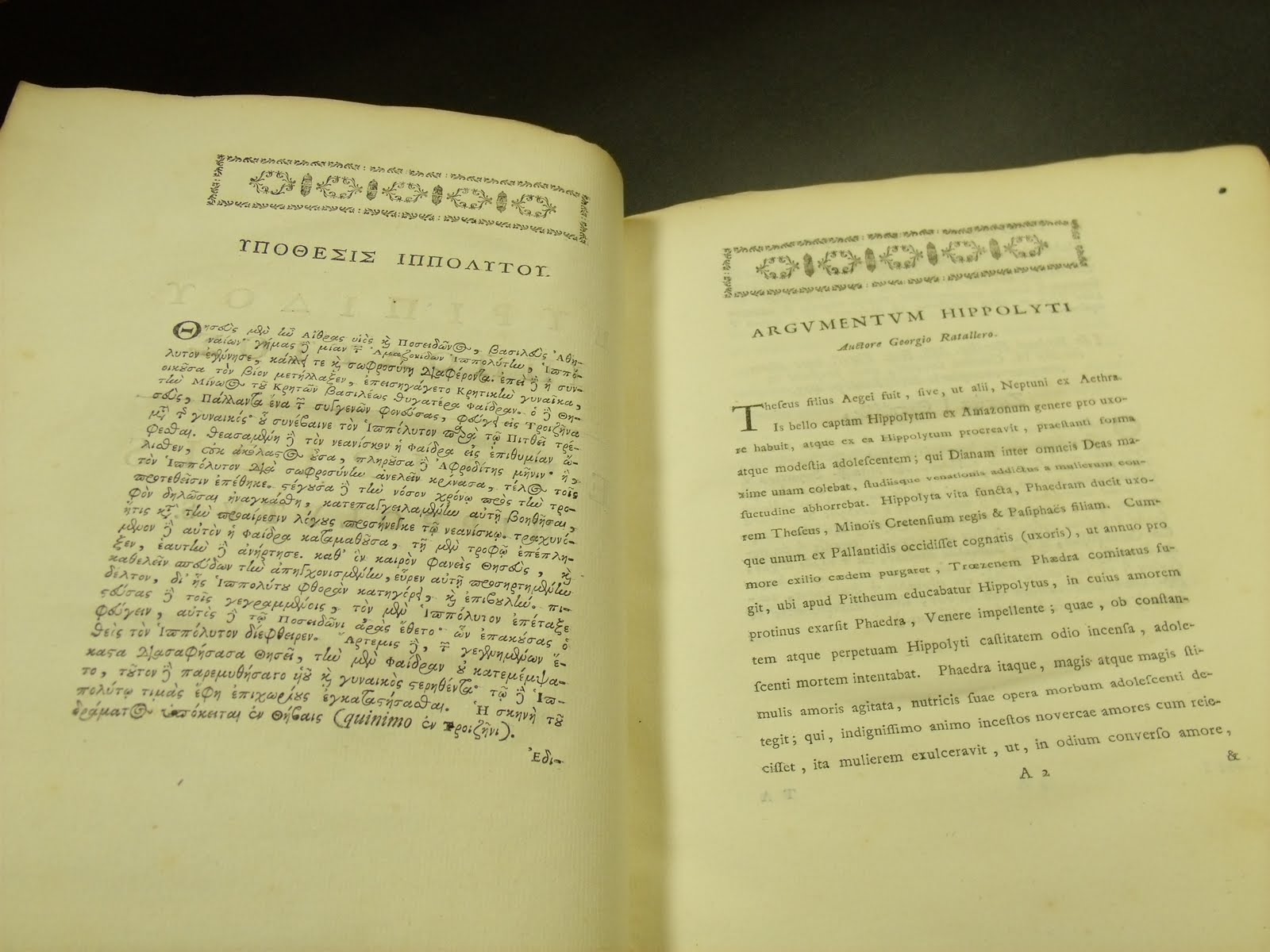
Euripides Tragoediae Hippolytus

My name is Cherrelle. I’m a senior here at Eastern Kentucky University. I’m an Anthropology major and I work downstairs in the library archives. I’ve been working here since my junior year here at Eastern. I’ve seen so many interesting things for the past year or so. There’s so much I want to write about, but after the Java City water disaster upstairs, that threatened the health of our very old, over-sized, and beautiful books, I was inspired to pick a book from that section to focus on.
I found a book that is titled Euripides Tragoediae Hippolytus. I’m having trouble figuring out what exactly this book is. It’s in really hard binding that’s been warped so much that the book doesn’t close normally anymore. The book is written in both Latin and Greek, so that makes it doubly hard to know what it’s about because I don’t know Latin or Greek. I looked up the book online to see if any site could just tell me what the book is and what it’s about. I got nothing particularly about the book, but a site did tell me that Euripides was a great Greek dramatic poet, who was born in 480 B.C.
From reading his various biographies online, I understand that the book in my possession is supposed to be the Hippolytus. The Hippolytus is an Ancient Greek tragedy by Euripides, based on the myth of Hippolytus, son of Theseus. The play was first produced for the City Dionysia of Athens in 428 B.C. and won first prize as part of a trilogy. From the description online, I don’t believe that the book here is this play. I am determined to find out what this book actually is. [1]

[1] Written October 8, 2010
Hi, it’s Cherrelle again. After my good, relaxing, and short Fall Break I came back to work intent on finding out what this mysterious book is that I found down here in the University Archives. Once again the title on the book label is Euripidis Tragoediae Hippolytus. I am ready to accept that the book in front of me is the play that I discovered online in my research, but I want more evidence to prove to me that’s what it is.
On the cover of the book, there is a seal of some kind with lions, a crown, and a phrase in Latin that says “per angvsta ad avgvsta.” I used Google Translate to figure out what that means and it came up with “through narrow to stately.” I looked up the phrase online and the results came back with several variations of the same thing; “through difficulties to honors,” “through difficulties to greatness,” and “through trial to triumph.” I’m not sure what the coat of arms means and now I’m determined to find that out.
Also on the cover of this book is, I assume, a Greek letter Y. It obviously has some sort of significance, so I looked it up online to find out what that meaning is. According to www.alphabetandletter.com, Y is descended from the Semitic letter vau, which the Greeks borrowed for their vowel upsilon. Y has long been considered a philosophical letter — a symbol of moral decision — because of its forked top. It is also known as the Pythagorean letter because Pythagoras is suspected of inventing it.
I am convinced the book in my possession is the play that I found online. Through a closer look at the book, flipping through each page, I found the play after a section titled “Argvmentvm Hippolytus.” The play itself is just under 150 pages. The play’s characters are Aphrodite, Hippolytus, Attendants, Nurse, Phaedra, Theseus, Messenger, and Artemis. The play is about scorned woman, who is the one woman you truly don’t want to scorn, Aphrodite. Hippolytus was wanted to pledge his life, in chaste, to Artemis instead of Aphrodite. Aphrodite became livid and made Phaedra, Theseus’ wife and Hippolytus’ step-mother, fall in love with Hippolytus. When Hippolytus didn’t return her love, she wrote a note to Theseus saying that Hippolytus raped her and she hung herself. Theseus believed his wife and banished Hippolytus. Theseus prayed to Poseidon for Hippolytus’ death. As Hippolytus was dying, Artemis appears and tells Theseus the truth. She explains that his son was innocent and that it was Phaedra who lied. Although the goddess admonishes Theseus' decision, she ultimately recognizes that the blame falls on Aphrodite. Hippolytus is carried in half alive, and Artemis promises to take revenge on Aphrodite by punishing anyone that Aphrodite loves. Finally, Hippolytus forgives his father, and then he dies. This story is about Aphrodite’s fury and what she can do with it. So if you can read Latin or Greek, you can come down here and ask for this book and read this beautiful Greek tragedy yourself and appreciate it in its entirety.[1]


This is my third day working on the blog for the book Euripidis Tragoediae Hippolytus. I’ve come to the conclusion that the book is the play that my research has led me to. The coat of arms that is on the front of the book looks a lot like the Belgium coat of arms. From researching the publishers’ names, Luzac and le Mair, on the title page, I understand that there is a connection between them and a place known as Leiden. Leiden is in Holland. Also on the title page is “Lugduni Batavorum” which translates to New York, which in Dutch means Leiden. I looked up Lugdunum Batavorum and came up with a town in Holland known now as Brittenburg, which is west of Leiden. So the book was published in Leiden and written in, or translated to, Greek and Latin by Johannes Luzac and Johannes le Mair in 1768.

While researching the story behind Brittenburg, I keep running into sites that say that Leiden was connected to Lugdunum. The Brittenburg is a Roman ruin west of Leiden. Brittenburg was part of the Roman border defense which formed the northern frontier of the Roman province Germania Inferior. Lugdunum was a naval base and fortified military granary at the estuary of the river Rhine. I found an interesting story about Brittenburg that I think should be shared. In 40, the emperor Caligula arrived at the beach with many soldiers and then told them to gather sea shells and fill up their helmets and pockets with them. In the winter of 39/40, a military base was constructed at nearby Valkenburg. It was called Praetorium Agrippinae; the first component of this name means 'headquarters', the second is a reference to the emperor's mother Agrippina. The presence of the emperor at the mouth of the Rhine is definite, because a barrel has been found that once contained wine from the emperor's personal vineyards. As late as the sixteenth century, fishermen from Katwijk called a group of underwater ruins 'the tower of Kalla'. So now the military base that was Brittenburg, or Lugdunum, is now partly buried by the beach and underwater. It is inaccessible by archaeologists. Now the Roman castle is known as a ghostly apparition that can sometimes be seen at night across the sea.
Lugdunum Batavorum, or New York, or Brittenburg, or Leiden, is where the book was translated and published. But the coat of arms on the front of the book might tell me who the book was published for. Online there is a copy of the book available for purchase with a price of £300, whose description says that there is a “gilt device” of Caius College, at Cambridge on the front. Maybe the coat of arms on the front of the copy here will tell me who this copy was intended for. Today, once again, I come up with nothing on the coat of arms.[2]


[1] Written October 13, 2010
[2] Written October 15, 2010

Wednesday, October 13, 2010

Dante's Discovery

So many moments out of a day, people tend to carry on with their worries and never take the time to enjoy the little treasures that have jeweled their lives. They just move from one task to another, never really seeing or appreciating what is sometimes resting directly before them, like a book on a shelf. But every now and then, those books have to be taken out of their slumber and in those instances, history awakens to allow one a glimpse into its depths. And today, history awoke to show me a gem of the University Archives that had long been forgotten, a collection of drawings for Dante’s Inferno by famous American artist Robert Rauschenberg.
At first, I had no idea what I had stumbled across on the shelves of the Special Collections in the University Archives. But as I began researching Dante’s Inferno (in light of the Halloween holiday) and researching the massive body of drawings and the artist Robert Rauschenberg, I realized Eastern has something in common with the Museum of Modern Art: this collection (though ours is number 260 out of 300 sets distributed with 1 of 43 signed lithographs).
Rauschenberg was a leading artist in the movement of Pop Art in the 1950s and 60s and this collection for Dante’s Inferno is among his most popular works. He was famous for his non-traditional style of mixing techniques and in these particular works, for layering various pieces of art forms (magazines, newspapers, paintings, etc.) and using water to manipulate the ink, paints, charcoal, etc. Not only are his techniques unique, but the works themselves and more importantly, the concepts are key elements in Rauschenberg’s style.
These breakthrough styles allowed him to win several awards during his lifetime from 1925 to 2008, including: the Grand Prize, 32nd Venice Biennale (1964); Creative Arts Award, Brandeis University, Waltham, Massachusetts (1978); Grand Prix d’Honneur, International Exhibition of Graphic Art, Ljubljana, Yugoslavia (1979); Gold Medal for Graphics, Oslo (1979); Skowhegan Medal for Painting, Skowhegan College, Maine (1982); Grammy Award for the best album design for the pop group Talking Heads (1984); Jerusalem Prize for Arts and Letters, Friends of Bezalel Academy of Jerusalem, Philadelphia Chapter (1984); Golden Plate Award, 25th Anniversary Salute to Excellence, American Academy of Achievement (1986); International Center of Photography Art Award (1987); The Algur H. Meadows Award of Excellence in the Arts, Meadows School of the Arts, Southern Methodist University, Dallas (1989); Federal Design Achievement Award (1992); National Medal of Arts Award presented by the U.S. President and First Lady (1993); Second Hiroshima Art Prize, Hiroshima Museum of Contemporary Art (1993); “Leonardo da Vinci” World Award of Arts, World Cultural Council, Mexico City (1995); Lifetime Achievement Award in Contemporary Sculpture, International Sculpture Center, Washington, D.C. (1996); First Prize in Contemporary Arts Awards, ARCO and Fundación Argentaria, Madrid (1997); The Eighth Wexner Prize, Wexner Center, Ohio State University (2000); The Harbourfront Centre World Leaders Prize, Toronto, Ontario (2001); Medal Award, The School of the Museum of Fine Arts, Boston (2002).
Obviously, Rauschenberg was and still is a huge artistic icon (though he passed away in
2008 from heart failure). He changed the entire perception of art and created a revolution that swept the entire nation, much like the literary classic of Dante’s Inferno itself, which is what originally led me to the discovery of the drawings for Dante's Inferno by Robert Rauschenberg.
Although there are many various versions of Dante's Inferno, Eastern's Archives holds a version printed by P.F. Collier in 1861 and translated by the Rev. Henry Francis Cary with illustrations by M. Gustave Dore. The beautiful bound cover features an embossed gold and black etching. Though little is known about this particular version, Dore first published his illustrations in 1861 and Cary is one of the well-known translators for Dane's Inferno. Nonetheless, the book is beautiful to examine and a true original that's available at a moment's notice.

So I write this blog in hopes that you'll take the time to notice what's right before your eyes. Whether it be a good book, a beautiful piece of art, or your own personal collection of memorabilia, take a moment to really see what's around you. Make a discovery. Absorb some new knowledge. Take advantage of today's opportunities. =)