Wednesday, November 3, 2010

EKU Alma Mater

EKU's Alma Mater written by Nancy Evans and arranged by Jane Campbell, music orchestra professor from 1926 to 1967, was first played at commencement in 1933. The following video clip is from the 1988 Spring Commencement. The lyrics follow.


Eastern Alma Mater

Hail to thee our Alma Mater,

Faithful guide of youth,

Holding high amid the darkness

Duty, light, and truth;

Still above, the skies attend thee,

Still thy stately columns stand,

Still thy sons and daughters love thee

Sing thy praises o’er the land.

All the earth’s resplendent beauty

Nature gathered here,

Rolling lawns and trees and grasses

On thy hillsides fair;

Happy days within thy shadow,

Friends and comrades we have won.

Fill our hearts with exaltation

For thy task so nobly done.

When beloved Alma Mater

Memory recalls

Other days of youth and laughter

In thy gracious halls;

When thy sons and daughters scattered

Turn again to thee,

Still thy lamp is brightly lighting

Us afar, that we may see.

Music by Jane Campbell

Words by Nancy Evans

Tuesday, November 2, 2010

John Grant Crabbe Library: Changing Spaces

The slide show that ran during the Noel Studio dedication Friday can be viewed online. Enjoy!

Monday, October 18, 2010

Euripides Tragoediae Hippolytus

My name is Cherrelle. I’m a senior here at Eastern Kentucky University. I’m an Anthropology major and I work downstairs in the library archives. I’ve been working here since my junior year here at Eastern. I’ve seen so many interesting things for the past year or so. There’s so much I want to write about, but after the Java City water disaster upstairs, that threatened the health of our very old, over-sized, and beautiful books, I was inspired to pick a book from that section to focus on.
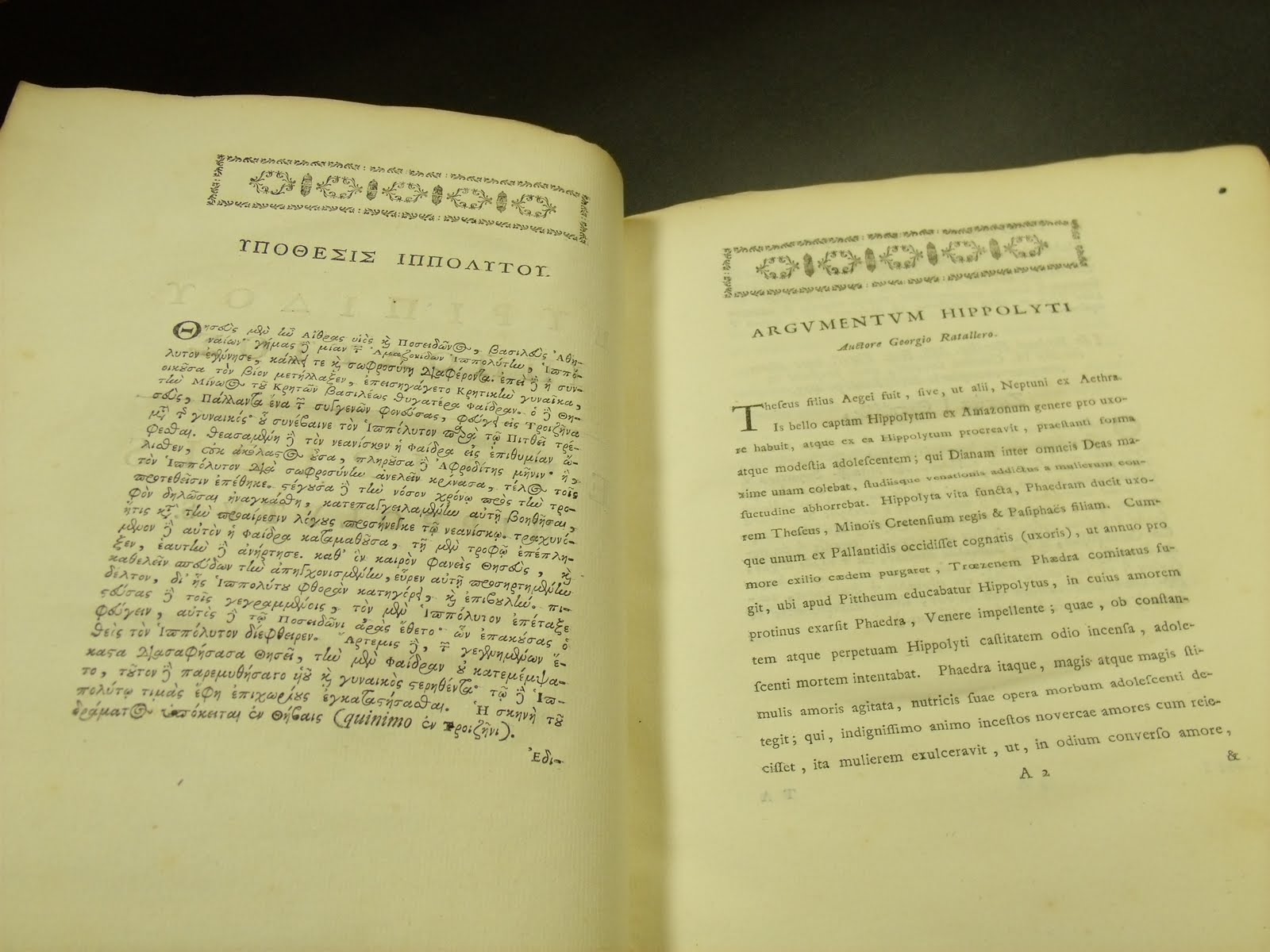
I found a book that is titled Euripides Tragoediae Hippolytus. I’m having trouble figuring out what exactly this book is. It’s in really hard binding that’s been warped so much that the book doesn’t close normally anymore. The book is written in both Latin and Greek, so that makes it doubly hard to know what it’s about because I don’t know Latin or Greek. I looked up the book online to see if any site could just tell me what the book is and what it’s about. I got nothing particularly about the book, but a site did tell me that Euripides was a great Greek dramatic poet, who was born in 480 B.C.
From reading his various biographies online, I understand that the book in my possession is supposed to be the Hippolytus. The Hippolytus is an Ancient Greek tragedy by Euripides, based on the myth of Hippolytus, son of Theseus. The play was first produced for the City Dionysia of Athens in 428 B.C. and won first prize as part of a trilogy. From the description online, I don’t believe that the book here is this play. I am determined to find out what this book actually is. [1]

[1] Written October 8, 2010
Hi, it’s Cherrelle again. After my good, relaxing, and short Fall Break I came back to work intent on finding out what this mysterious book is that I found down here in the University Archives. Once again the title on the book label is Euripidis Tragoediae Hippolytus. I am ready to accept that the book in front of me is the play that I discovered online in my research, but I want more evidence to prove to me that’s what it is.
On the cover of the book, there is a seal of some kind with lions, a crown, and a phrase in Latin that says “per angvsta ad avgvsta.” I used Google Translate to figure out what that means and it came up with “through narrow to stately.” I looked up the phrase online and the results came back with several variations of the same thing; “through difficulties to honors,” “through difficulties to greatness,” and “through trial to triumph.” I’m not sure what the coat of arms means and now I’m determined to find that out.
Also on the cover of this book is, I assume, a Greek letter Y. It obviously has some sort of significance, so I looked it up online to find out what that meaning is. According to www.alphabetandletter.com, Y is descended from the Semitic letter vau, which the Greeks borrowed for their vowel upsilon. Y has long been considered a philosophical letter — a symbol of moral decision — because of its forked top. It is also known as the Pythagorean letter because Pythagoras is suspected of inventing it.
I am convinced the book in my possession is the play that I found online. Through a closer look at the book, flipping through each page, I found the play after a section titled “Argvmentvm Hippolytus.” The play itself is just under 150 pages. The play’s characters are Aphrodite, Hippolytus, Attendants, Nurse, Phaedra, Theseus, Messenger, and Artemis. The play is about scorned woman, who is the one woman you truly don’t want to scorn, Aphrodite. Hippolytus was wanted to pledge his life, in chaste, to Artemis instead of Aphrodite. Aphrodite became livid and made Phaedra, Theseus’ wife and Hippolytus’ step-mother, fall in love with Hippolytus. When Hippolytus didn’t return her love, she wrote a note to Theseus saying that Hippolytus raped her and she hung herself. Theseus believed his wife and banished Hippolytus. Theseus prayed to Poseidon for Hippolytus’ death. As Hippolytus was dying, Artemis appears and tells Theseus the truth. She explains that his son was innocent and that it was Phaedra who lied. Although the goddess admonishes Theseus' decision, she ultimately recognizes that the blame falls on Aphrodite. Hippolytus is carried in half alive, and Artemis promises to take revenge on Aphrodite by punishing anyone that Aphrodite loves. Finally, Hippolytus forgives his father, and then he dies. This story is about Aphrodite’s fury and what she can do with it. So if you can read Latin or Greek, you can come down here and ask for this book and read this beautiful Greek tragedy yourself and appreciate it in its entirety.[1]


This is my third day working on the blog for the book Euripidis Tragoediae Hippolytus. I’ve come to the conclusion that the book is the play that my research has led me to. The coat of arms that is on the front of the book looks a lot like the Belgium coat of arms. From researching the publishers’ names, Luzac and le Mair, on the title page, I understand that there is a connection between them and a place known as Leiden. Leiden is in Holland. Also on the title page is “Lugduni Batavorum” which translates to New York, which in Dutch means Leiden. I looked up Lugdunum Batavorum and came up with a town in Holland known now as Brittenburg, which is west of Leiden. So the book was published in Leiden and written in, or translated to, Greek and Latin by Johannes Luzac and Johannes le Mair in 1768.

While researching the story behind Brittenburg, I keep running into sites that say that Leiden was connected to Lugdunum. The Brittenburg is a Roman ruin west of Leiden. Brittenburg was part of the Roman border defense which formed the northern frontier of the Roman province Germania Inferior. Lugdunum was a naval base and fortified military granary at the estuary of the river Rhine. I found an interesting story about Brittenburg that I think should be shared. In 40, the emperor Caligula arrived at the beach with many soldiers and then told them to gather sea shells and fill up their helmets and pockets with them. In the winter of 39/40, a military base was constructed at nearby Valkenburg. It was called Praetorium Agrippinae; the first component of this name means 'headquarters', the second is a reference to the emperor's mother Agrippina. The presence of the emperor at the mouth of the Rhine is definite, because a barrel has been found that once contained wine from the emperor's personal vineyards. As late as the sixteenth century, fishermen from Katwijk called a group of underwater ruins 'the tower of Kalla'. So now the military base that was Brittenburg, or Lugdunum, is now partly buried by the beach and underwater. It is inaccessible by archaeologists. Now the Roman castle is known as a ghostly apparition that can sometimes be seen at night across the sea.
Lugdunum Batavorum, or New York, or Brittenburg, or Leiden, is where the book was translated and published. But the coat of arms on the front of the book might tell me who the book was published for. Online there is a copy of the book available for purchase with a price of £300, whose description says that there is a “gilt device” of Caius College, at Cambridge on the front. Maybe the coat of arms on the front of the copy here will tell me who this copy was intended for. Today, once again, I come up with nothing on the coat of arms.[2]


[1] Written October 13, 2010
[2] Written October 15, 2010

Wednesday, October 13, 2010

Dante's Discovery

So many moments out of a day, people tend to carry on with their worries and never take the time to enjoy the little treasures that have jeweled their lives. They just move from one task to another, never really seeing or appreciating what is sometimes resting directly before them, like a book on a shelf. But every now and then, those books have to be taken out of their slumber and in those instances, history awakens to allow one a glimpse into its depths. And today, history awoke to show me a gem of the University Archives that had long been forgotten, a collection of drawings for Dante’s Inferno by famous American artist Robert Rauschenberg.
At first, I had no idea what I had stumbled across on the shelves of the Special Collections in the University Archives. But as I began researching Dante’s Inferno (in light of the Halloween holiday) and researching the massive body of drawings and the artist Robert Rauschenberg, I realized Eastern has something in common with the Museum of Modern Art: this collection (though ours is number 260 out of 300 sets distributed with 1 of 43 signed lithographs).
Rauschenberg was a leading artist in the movement of Pop Art in the 1950s and 60s and this collection for Dante’s Inferno is among his most popular works. He was famous for his non-traditional style of mixing techniques and in these particular works, for layering various pieces of art forms (magazines, newspapers, paintings, etc.) and using water to manipulate the ink, paints, charcoal, etc. Not only are his techniques unique, but the works themselves and more importantly, the concepts are key elements in Rauschenberg’s style.
These breakthrough styles allowed him to win several awards during his lifetime from 1925 to 2008, including: the Grand Prize, 32nd Venice Biennale (1964); Creative Arts Award, Brandeis University, Waltham, Massachusetts (1978); Grand Prix d’Honneur, International Exhibition of Graphic Art, Ljubljana, Yugoslavia (1979); Gold Medal for Graphics, Oslo (1979); Skowhegan Medal for Painting, Skowhegan College, Maine (1982); Grammy Award for the best album design for the pop group Talking Heads (1984); Jerusalem Prize for Arts and Letters, Friends of Bezalel Academy of Jerusalem, Philadelphia Chapter (1984); Golden Plate Award, 25th Anniversary Salute to Excellence, American Academy of Achievement (1986); International Center of Photography Art Award (1987); The Algur H. Meadows Award of Excellence in the Arts, Meadows School of the Arts, Southern Methodist University, Dallas (1989); Federal Design Achievement Award (1992); National Medal of Arts Award presented by the U.S. President and First Lady (1993); Second Hiroshima Art Prize, Hiroshima Museum of Contemporary Art (1993); “Leonardo da Vinci” World Award of Arts, World Cultural Council, Mexico City (1995); Lifetime Achievement Award in Contemporary Sculpture, International Sculpture Center, Washington, D.C. (1996); First Prize in Contemporary Arts Awards, ARCO and Fundación Argentaria, Madrid (1997); The Eighth Wexner Prize, Wexner Center, Ohio State University (2000); The Harbourfront Centre World Leaders Prize, Toronto, Ontario (2001); Medal Award, The School of the Museum of Fine Arts, Boston (2002).
Obviously, Rauschenberg was and still is a huge artistic icon (though he passed away in
2008 from heart failure). He changed the entire perception of art and created a revolution that swept the entire nation, much like the literary classic of Dante’s Inferno itself, which is what originally led me to the discovery of the drawings for Dante's Inferno by Robert Rauschenberg.
Although there are many various versions of Dante's Inferno, Eastern's Archives holds a version printed by P.F. Collier in 1861 and translated by the Rev. Henry Francis Cary with illustrations by M. Gustave Dore. The beautiful bound cover features an embossed gold and black etching. Though little is known about this particular version, Dore first published his illustrations in 1861 and Cary is one of the well-known translators for Dane's Inferno. Nonetheless, the book is beautiful to examine and a true original that's available at a moment's notice.

So I write this blog in hopes that you'll take the time to notice what's right before your eyes. Whether it be a good book, a beautiful piece of art, or your own personal collection of memorabilia, take a moment to really see what's around you. Make a discovery. Absorb some new knowledge. Take advantage of today's opportunities. =)

Tuesday, September 21, 2010

Eastern Kentucky State Normal School

The latest statistics show that over 16,000 students are attending Eastern this semester. That is a long way from this early photo of Eastern Kentucky State Normal School.

This great photo, probably taken in 1921 was recently donated to the archives. The date is estimated from the appearance of the Memorial Hall Annex, the building on the far left. According to the Board of Regents minutes, bids were being accepted for light fixtures for the new building in April 1921 and in this photo the annex looks like construction is nearly complete.

Most of the Eastern community at the time was probably included in this photo. Students are letters, faculty and staff are dots. If you look closely President Coates is in the third dot from the right, and the last 's' includes students from Model Training School. There is a baseball game in the background and a tennis game on the far right where the library now stands.


Thank you Mrs. Agee for this great donation.

Wednesday, September 8, 2010

In the Days When Kentucky Came to California

You never know what you’re going to come across while working in the archives, especially when you’re unsure of what you’re looking for. When I began searching for a blog topic, I didn’t even know where to begin. There are so many interesting pieces just waiting to be uncovered. After much deliberation, I finally settled on a portion of a collection of Keen Johnson’s photographs from his time as Lieutenant Governor under "Happy" Chandler. Though KJ had tons of photos, I’m particularly drawn to the Hollywood Glam shots with stars like Shirley Temple, Loretta Young, Richard Greene, and many more.

In these particular photos, Governor Chandler and his family are spiffed up in their best duds at the movie premier of Kentucky at Carthay Circle Theatre in Los Angeles, California on December 14, 1938 (if you look closely at the marquee on the theater front, you can see this information very clearly). From the photo, one can see that the theater drew massive crowds, huge stars, and its fair share of paparazzi. Since its opening in 1926 and the following years, especially the 1930s and '40s, Carthay Circle Theatre was “the place” for big Hollywood releases for the Fox Corporation, such as Gone with the Wind, Romeo and Juliet, and even Walt Disney’s first animated feature Snow White and the Seven Dwarfs.

Though the true Carthay Circle Theatre met its demolition in 1969, Disney constructed its own replica of the theatre at its California Adventure park in Anaheim. The Carthay Circle Theatre exemplifies that as long as people are around to remember something, it most certainly won't be forgotten, but will carry on in a new form from generation to generation. I suppose that statement is true with much of the treasures here in the Archives. Each time something, from a photo to an old championship football to a famous autographed record, is found, there's a story to be interpreted and a piece of history to be recreated in the research.

Tuesday, September 7, 2010

What is the origin of the EKU Colonel?


In the 1920's, Eastern students who wished to be known as something other than "The Maroons" voted for the Leopard as the school mascot. A plan to purchase a leopard from the Memphis, Tennessee zoo came to nothing and the students remained Maroons.


In 1963 President Robert Martin established the Colonel as the mascot, who continues in that capacity to the present day. The original Colonel design was by Louisville Courier-Journal editorial cartoonist Hugh Haynie.
(Illustration by author)